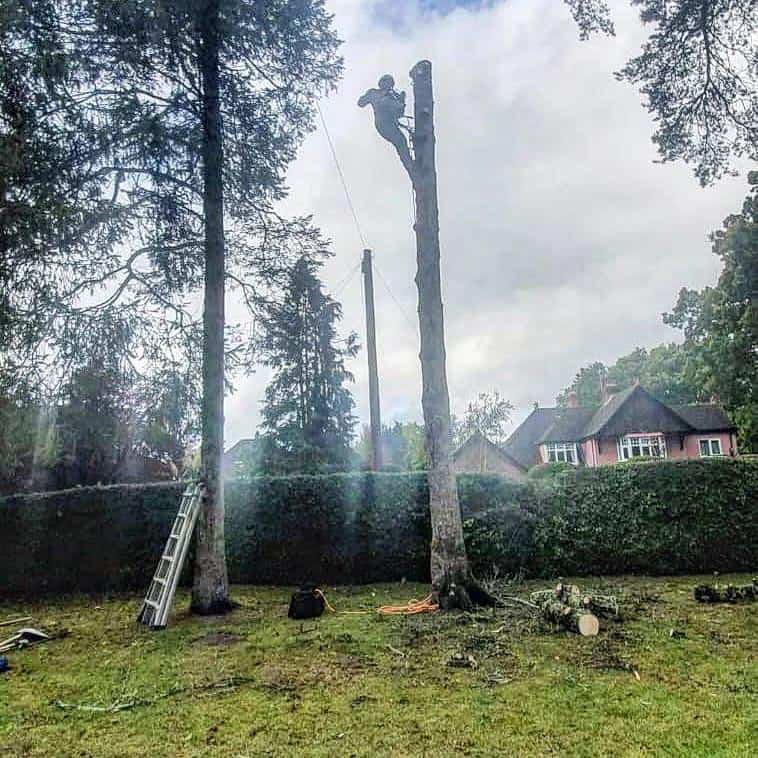
Crown reduction is a precise tree surgery technique used to decrease the height or spread of a tree while retaining its natural shape. It may be recommended when a tree has become too large for its surroundings, contains overextended branches or needs better balance within the garden.
The success of the work depends heavily on how much growth is removed. Reducing too little may not resolve the original concern, while excessive pruning can weaken the tree and produce poor regrowth. For trees in Portsmouth, Hampshire, the appropriate reduction should therefore be based on professional assessment rather than an arbitrary percentage.
How the Extent of Crown Reduction Affects a Tree
Every pruning cut changes the tree’s structure and removes some of its leaf-bearing canopy. A carefully planned reduction aims to achieve the required improvement while retaining enough healthy foliage and well-positioned branches to support the tree.
The Canopy Supports the Tree’s Vital Processes
Leaves allow a tree to produce the energy it needs for growth, maintenance and recovery. Removing a large proportion of the canopy at once can substantially reduce this capacity.
A moderate reduction retains sufficient foliage and distributes the pruning across the crown. This gives the tree a better opportunity to respond without placing unnecessary stress on the remaining structure.
Excessive Reduction Can Trigger Weak Regrowth
When too much canopy is removed, some trees respond by producing vigorous new shoots. These shoots can grow rapidly and may be less securely attached than the original branches.
The result can be a dense outer canopy that requires further management. Careful crown reduction seeks to avoid provoking this response by limiting pruning to an amount the tree can reasonably tolerate.
Natural Shape Should Be Preserved
A properly reduced tree should retain a recognisable and balanced outline. Each main branch is shortened back to an appropriate side branch rather than cut at an arbitrary point.
Removing excessive growth can leave the crown sparse, uneven or disfigured. It may also create large gaps between the remaining branches. Planning the reduction across the whole canopy helps preserve the tree’s natural form.
Large Cuts Create Larger Wounds
Trees respond to pruning wounds by forming protective growth around the exposed area. Smaller, well-positioned cuts are generally easier for a tree to manage than unnecessarily large cuts.
An excessive reduction may require the removal of major limbs, creating wounds that remain exposed for longer. Professional crown reduction therefore prioritises carefully selected branch ends and suitable pruning points wherever possible.
Tree Species Respond Differently
Not all trees tolerate crown reduction in the same way. Species differ in their growth habits, ability to produce new shoots and response to pruning wounds.
The tree’s age, condition and previous maintenance also influence how much can be removed appropriately. A reduction suitable for one tree may be excessive for another, even when they are similar in size.
The Reason for the Work Determines the Reduction
The amount removed should relate directly to the problem being addressed. A tree may need crown reduction to:
- shorten long, overextended branches
- improve balance within an uneven canopy
- create clearance around garden features
- reduce excessive spread
- manage the overall size of the crown
- lessen weight at selected branch ends
A general reduction is not always necessary. Where only one part of the tree is causing difficulty, selective work may achieve the desired result while retaining more of the healthy canopy.
Balance Must Be Maintained Across the Crown
Reducing one side of a tree heavily while leaving the other untouched can create poor proportions and concentrate weight in the remaining canopy.
A tree surgeon assesses how each proposed cut will affect the overall structure. Even where more work is required on one side, the finished crown should retain a coherent framework and an appropriate distribution of growth.
Previous Pruning Influences What Can Be Done
A tree that has been reduced before may contain old pruning points, dense regrowth or areas with limited suitable branches. These features affect where new cuts can be positioned.
Repeating reductions at unsuitable points can produce clusters of weak shoots and an increasingly unnatural outline. A professional assessment helps determine whether the previous framework can be used or whether a different pruning approach is required.
A Staged Reduction May Be More Appropriate
Where a substantial change is needed, removing the desired amount in one visit may place too much stress on the tree. The work can sometimes be divided into planned stages.
A staged approach allows the tree to respond between pruning visits and gives the tree surgeon an opportunity to assess how new growth is developing. This can provide greater control over the final shape.
Crown Reduction Is Not the Same as Topping
Topping involves indiscriminate cuts that remove large sections of branches without following the tree’s natural structure. This can leave large wounds, an unbalanced crown and vigorous regrowth.
Professional crown reduction uses selective cuts to suitable growth points. The goal is to reduce dimensions while maintaining a functional branch framework, not simply to make the tree shorter as quickly as possible.
Why Professional Judgement Matters
Deciding how much to remove requires more than measuring the tree’s height. A tree surgeon must consider:
- species and growth characteristics
- age and general condition
- branch structure and existing defects
- previous pruning history
- the position of suitable pruning points
- the purpose of the reduction
- how the remaining crown will be balanced
These factors allow the work to be tailored to the individual tree rather than applying the same reduction to every situation.
Conclusion
The amount removed during crown reduction affects the tree’s health, structure, appearance and future growth. A carefully judged reduction can manage size and overextended branches while retaining a balanced canopy. Excessive pruning may create stress, weak regrowth and an unnatural form.
If a tree at your property in Portsmouth, Hampshire requires crown reduction, LM Tree Surgery Portsmouth can assess its structure and recommend a proportionate approach. Contact the team to arrange a professional tree assessment.
Call us on: 023 8235 3287
Click here to find out more about LM Tree Surgery Portsmouth
Click here to complete our contact form and see how we can help with your trees needs.